

The Semantic Layer: Why 30 Years of Tech Haven’t Stopped Boardroom Arguments
August 11, 2026
When to Hire a Fractional CDO: 5 Strategic Sprints
August 19, 2026Inside a 90,000-Customer Fintech’s AI Infrastructure Playbook

“If your data is not of good quality,” Vora said, “the AI cannot produce good results.”
That statement sounds obvious. Executives nod when they hear it. But then they go back to evaluating AI platforms and assume that any data quality issues will be resolved before launch.
It doesn’t work that way. By the time the results come back wrong, the weakness of their data foundation is already baked in.
Kinnar Vora is VP of Engineering at Forward Financing, a Boston-based fintech providing capital to more than 90,000 small businesses. When Alex Kangoun, CEO of
Athena Solutions asked what keeps him up at night, Vora’s answer wasn’t the AI agents his team is deploying. It was worrying about the quality of the data driving them.
The Moment AI Exposes What Was Already There
According to a Q3 2024 Gartner survey of 248 data management leaders, 63% of organizations either don’t have the right data management practices for AI or aren’t sure they do. That number means most executives reading this are mid-deployment, with a data foundation that was never designed to support AI.
Alex Kangoun put it plainly: “There’s no glory in preparing data. Everybody wants to work on the model. The data work is invisible until the model fails.”
And failure arrives at the worst possible moment: after the platform is built. After the board has gone all-in. After the budget and timelines have already been allocated.
For a CEO with their reputation on the line, the timing of those failures couldn’t be worse.
What Data Quality for AI Actually Requires
Vora’s team took an entirely different approach. They built governance infrastructure: tooling, governance models, and continuous quality monitoring. They understood from the beginning that data quality for AI is a standard you have to maintain, not a state you reach.
“Data quality is not a one-time task,” Vora said. “It’s an ongoing task. We looked at our data quality, and we are building a lot of tooling. We’re creating governance models, getting tools in place. That work changes every single day.”
“The inputs that you give to the AI on what it’s making the decisions on… If that’s not fully accurate or fully clean, then you’re not going to get the answers that you expect.”
Forward Financing operates in the highly regulated lending space, making real-time capital decisions for small businesses. Funding decisions run two to four hours from application to approval. When Vora’s team examined their data foundation, what they found wasn’t a one-time cleanup project. It was an operating challenge that required dedicated tooling and processes to maintain.
How Forward Financing Built for AI
Vora described the organizational structure Forward Financing built to make it operational.
At the center is what he calls his AI lab: a small team of four engineers, with a direct line to the CEO and cross-functional access to multiple business teams. The lab’s mandate is to understand the business challenges each team faces, identify where AI can help ease the lift, and build toward that goal without losing sight of the data foundation that makes it all work.
“We cut across every single department,” Vora said. “We talk with strategy, finance, HR, and operations… We get a holistic view of what each team is dealing with and what the common asks are.”
This structure succeeds for two reasons. First, a cross-functional team surfaces business-centric data quality problems that a purely technical team might miss. Second, having a direct line to the CEO means that when data quality work competes for resources with higher-visibility AI projects, it doesn’t automatically lose.
Alex Kangoun frames this as a first-principles question. “Technology’s main goal is to support the business. An executive leadership team that understands data quality as a production dependency invests in it. This is a key difference from companies that don’t.”
What Breaks When the Foundation Isn't Ready
The consequences of treating data quality as a one-time fix are predictable.
Outputs that were accurate at launch become less accurate over time as the underlying data drifts, with no visible signal that anything has changed. In a lending environment like Forward Financing’s, that drift can lead to bad lending decisions, unnecessary risk, and severe financial consequences.
Data governance frameworks that prevent data drift come down to one key aspect: ownership. Someone has to be responsible for data quality in each domain, with the expertise to spot problems early and the authority to act when quality slips. Vora’s team established that before anything went to production.
Vora put the underlying logic plainly: “The house of AI is built on the foundation of data.”
What an Ongoing Data Quality Standard Actually Looks Like
What Forward Financing built is a continuous operating model.
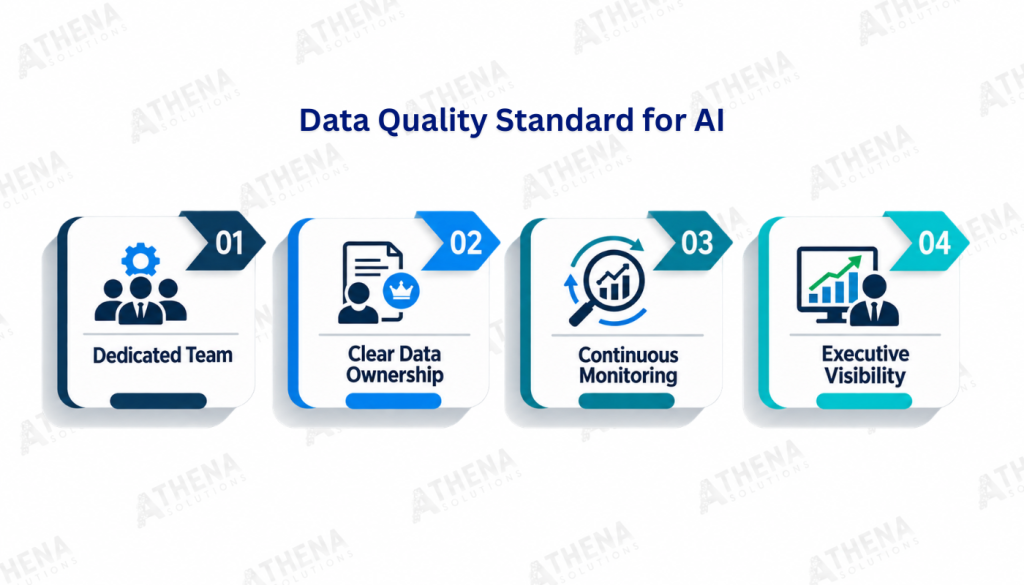
- A small dedicated team with cross-functional visibility
- Governance models that define who owns data quality at each stage of the pipeline
- Tooling that monitors quality in near-real time rather than at quarterly audit intervals
- Reporting lines to executive leadership so that data quality problems surface before they become AI accuracy problems.
This is a sound data foundation for AI.
The companies that get data quality for AI right treat the foundation as seriously as the technology sitting on top of it. They assign data ownership. Build dedicated tooling. Connect quality to executive decision-making. And treat the work as an ongoing mission and staff it accordingly.
Kinner Vora’s team is confident in their AI agents operating in production because of what they built beneath the technology, not just in the tech itself.
Beyond the Demo: Building an AI Standard That Lasts
The companies winning with AI right now did the all-important groundwork first. Governance frameworks. Continuous data quality for AI monitoring. Clear ownership assigned to data quality as an ongoing operational function.
That’s the AI data problem organizations discover too late: the foundation was never built to withstand what they stacked on top of it.
This is the work that many AI deployments skip. During production, they find out it was a critical mistake.
Fix The Data First
Don’t wait for production failures to expose the cracks in your data foundation. Before you sign off on your next major AI platform or initiative, have a clear-eyed look at your data’s current state.
Still not sure your data is AI-ready? Learn how an AI Readiness Assessment can safeguard your AI deployment.
Author: Alex Kangoun, CEO, Athena Solutions. Alex has spent 20+ years building data foundations for mid-market companies. He can be reached on LinkedIn.
Frequently Asked Questions
It refers to the accuracy, completeness, consistency, and timeliness of the data that AI models use to make decisions.
Data quality for AI is a continuous operational function. Periodic reviews are insufficient for AI running in production.
Data quality measures whether data is accurate, complete, and timely. AI data governance defines who owns data, who's accountable when quality falls, and what the remediation process looks like.
Before an AI initiative begins and before a platform is purchased is the right time. An AI Readiness Assessment surfaces gaps in data quality, governance, integration, and ownership — the organizational and data problems that determine whether AI will hold.

