

The Best BI Consulting Services: Build The Foundation First
June 15, 2026
AI Won’t Replace Your Team. But It Might Make Them Stronger
July 8, 2026The Strongest Tree on the Street Until It Wasn’t

The storm came through on a Saturday afternoon in early June. Spring wind and rainstorms are not uncommon in northern New England. This one was very angry.
I watched from my living room window as every tree on the street was bending violently back and forth. Branches fell, and new green leaves tore loose, swirling about in the storm before covering the ground. One tree did not move. My neighbor’s big maple.
I don’t know how old it was, but I thought it was the strongest tree on the block. While every other tree around it twisted in the wind, that old maple stood still. Eventually, the storm passed.
Then, I heard what sounded like branches falling. Returning to the window, I saw that the tree had come down, rather quietly. Its entire crown had snapped off and fallen across the driveway.
I went out to look at the damage. I’m not an arborist, but the tree appeared healthy. But as I examined it, it was dry and crumbling at its core, brittle enough to break apart in my hand.
From the outside, it looked strong. But all that new growth on top of a weakening foundation left it unable to bear its own weight.
A company’s data infrastructure can fall the same way. Under the weight of its technical debt.
How Fast Growth Weakens a Data Foundation
Fast-growing companies can look just as strong from the outside as that old maple tree. Until their foundation gives way. Every new initiative puts more load on legacy systems that nobody has reinforced. It might be the addition of a new product line or the absorption of an acquisition under a tight deadline. We’re seeing AI rollouts built on data that nobody had time or resources to assess for the quality level data that AI demands.
People hold these systems together with “scotch tape.” They reconcile numbers in spreadsheets, patch systems together manually, and create workarounds for whatever else doesn’t line up.
A company can run this way for years because people are carrying the burden. Their efforts keep things running, but none of it fixes what’s wrong.
The data foundation keeps weakening until one day it breaks.
The AI Load Test
Now it’s happening with AI. Gartner expects organizations to abandon 60% of AI projects in 2026 because their data isn’t AI-ready.
AI is the heaviest load companies have ever tried to put on their data foundation. Without a rigorous, upfront AI readiness assessment, the widespread failure to realize value from these projects should be no surprise.
The Familiar Shortcuts
Nobody has perfect data. What holds a foundation together is how a company reinforces its systems as it grows. The companies that struggle are almost always the ones that take shortcuts and never look back.
The shortcuts are familiar and usually necessary. But the price of them always comes due.
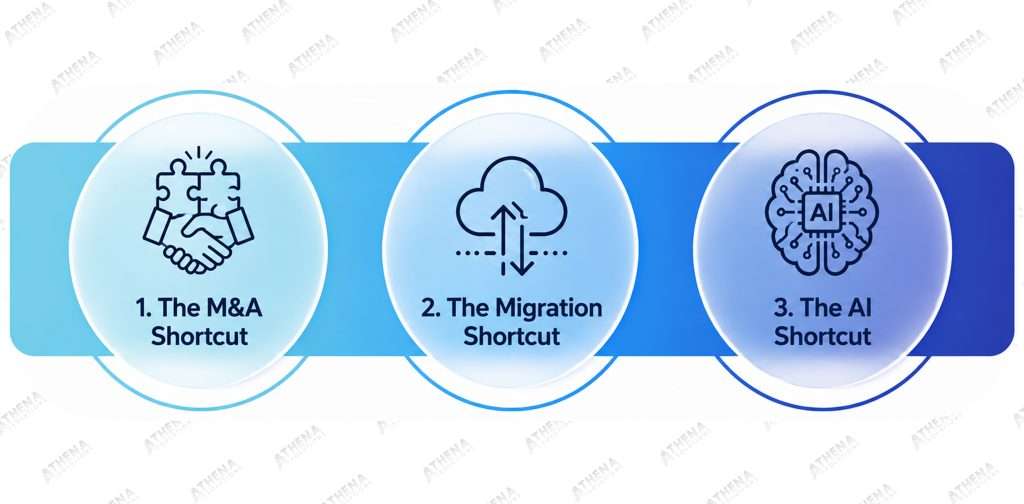
1. The M&A Shortcut
The most common shortcut happens during an acquisition or merger. Two legacy systems are patched together under a deadline. The data integration has to be done, and fast. Typically, when companies rush this process without a unified data integration framework, master data goes unresolved. Short-term patches replace sustainable data integration solutions, and the obvious problems for reporting, operations, and finance begin immediately, as there is no longer a single source of truth.
A full rebuild isn’t practical, but neither is doing nothing. Before the close or immediately after, agree on a single system of record for each critical data domain. Assign a named owner for each, one person and a backup. If time is short, start with the domain most likely to cause immediate pain. Worst first. Reconcile that one, and go on from there.
2. The Migration Shortcut
Another standard shortcut is migrating legacy system issues directly into the new foundation. New system, same data; errors, duplicates, legacy logic, and all. It wasn’t cleaned before the move because the deadline was impossible. Now, the problems are harder to find because they look like they belong there.
It is difficult to clean ten years of historical junk. So, you triage. Prioritize.
Leave your unused, historical data behind in a cheap, unmigrated archive. Focus 100% of your limited timeline on cleaning the active core. Then, set a strict validation gate at the entrance of the new system. If a record doesn’t meet basic quality rules, it’s rejected.
One company implementing a new CRM brought only one year of historical data; a deliberate decision to save on cloud costs and hit the deadline. It worked, until they stood up their AI model and realized it needed the full historical record to be useful. Historical data isn’t dead weight. For most AI models, it’s the foundation.
3. The AI Shortcut
Trying to stand up AI on data that isn’t ready for it is a leading cause of AI project failure. The tech won’t compensate for what the data lacks. It just uses whatever is there: the gaps, the duplicates, and every other unresolved quality issue.
Thinking “our data is good enough” is the most dangerous decision a company can make when thinking about AI investments. Good enough to run yesterday’s business is not the same as good enough for AI to make decisions without a human in the loop.
You don’t need a pristine data lakehouse to launch an AI tool. You restrict the scope. Instead of turning a model loose on your entire messy ecosystem, create a “bounded context.”
Pick one specific, high-value use case, such as an internal customer service copilot or an inventory forecasting tool for a single vendor, and clean only the data streams feeding that model. Build a tightly curated sandbox of verified data just for that initiative.
Prove the value in a controlled environment. Nail down the data definitions for that single pipeline, and expand your AI footprint use case by use case.
What all of these shortcuts have in common is the same silent agreement: We’ll live with it for now. Under intense deadline pressure, it feels like the only rational choice. And it probably is. But over time, “for now” becomes forever. The temporary patch becomes the permanent fix.
Which it isn’t.
What You Can't See
Taking these shortcuts isn’t lazy, but ‘we’ll get back and harden them’ loses every fight with the next deadline.
It doesn’t mean a complete teardown and rebuild of your data foundation is always the answer. But you do need a plan to go back and turn shortcuts and quick fixes into permanent solutions.
Otherwise, once the storm arrives, it comes down.
There Are No Permanent Shortcuts
I was certain that the old maple was the strongest tree on the street with that full crown extending over both driveways. It was the most certain thing in the yard, right up until it wasn’t.
New growth looks the same way to a company. It feels like strength, but it’s the health of the data foundation that nobody is thinking about when the last few quarters of earnings are excellent.
The companies standing tall are those whose foundations can hold what growth keeps adding. The ones that can’t are just building for a bigger fall.
So before the next acquisition, the new market, the AI rollout, or the next major bet.
The canopy will suggest the company is healthy, but only the core will prove whether it can withstand a storm.
If you want help hardening your systems to carry the next wave of growth, whether that means deploying targeted data governance consulting services, building secure data integration solutions, or modernizing your data architecture, that’s the work we do.

