

Avoiding The AI Readiness Self-Assessment Trap
June 4, 2026
Your Data Integration Solutions Works. So Why Doesn’t Your Data?
June 10, 2026Data Governance Solutions: What Works, What Fails, and Why

Companies searching for data governance solutions are really asking one of two questions.
- Which platform should we use?
- The second, usually asked six months later: Why isn’t it working?
Both are legitimate questions. They require very different answers.
Gartner tracks dozens of platforms purpose-built for governance: tools for data cataloging, data quality, metadata management, master data management, and data lineage. The availability of data governance solutions is not the problem.
The problem lies between the tool and the outcome: a governance framework built for how your firm actually works.
What Data Governance Solutions Actually Cover
Complete data governance solutions include both the technology platforms and the organizational programs built around them.
On the technology side, the market breaks into five categories:
- Data catalog and discovery tools are the inventory system for your data estate: what exists, where it lives, and how it is defined across systems.
- Data quality tools serve as the monitoring layer, flagging when data quality standards are not met.
- Master data management (MDM) platforms are the system of record for your core business entities: customers, products, and suppliers. One version. Across all systems.
- Data lineage tools create an audit trail for your data, tracking every transformation from source to consumption.
- Governance and policy platforms are the accountability layer: who owns what, who can access it, and what happens when something goes wrong.
These tools don’t establish accountability on their own. They don’t define who owns a data asset. They don’t resolve the dispute when Finance and Sales each report a different number for “active customers” heading into a board meeting. They don’t make anyone change how they work.
That’s the layer many data governance programs are missing, and it’s the layer that determines whether the technology investment pays off.
Why Tools Alone Aren't Enough
Gartner estimates the average cost of poor data quality at $12.9 million per year. Nobody argues with that number.What nobody talks about is why quality stays poor even after companies invest in governance platforms and tools.
The answer is almost always the same. Nobody establishes accountability for data quality. Nobody assigns data ownership.The program is designed around the tool: its features, workflows, and reporting dashboards.
- Nobody asks who is responsible when the data is wrong.
We see this across industries: financial services, healthcare, and manufacturing. The platform goes live, the dashboards look right, but six months later, two different business units are still pulling contradictory numbers because the definition dispute was never settled. It was documented, but never resolved. - Technology doesn’t fix that.
For mid-market companies considering an AI initiative, this isn’t academic. AI readiness depends on data governance as its foundation. A model trained on data with unresolved ownership conflicts or inconsistent definitions will magnify those problems on a scale and pace no analyst can detect manually.
If your data governance plan is “connect to a platform,” that’s a tool deployment, not a governance program.
What Good Data Governance Actually Looks Like
Good governance has three characteristics. It is specific. It is owned. And it adapts.
- Specific means your policies describe exactly how data is created, moved, transformed, and accessed in your firm, not in some hypothetical company the framework was designed for. A regional retailer reconciling inventory, pricing, and replenishment data across three separate systems needs policies that reflect each system specifically. Generic governance documents let everyone agree that governance is important without anyone having to change how they work.
- Owned means every critical data asset has a named owner and a named backup. Not a committee. I’ve watched governance councils spend months debating ownership structures and produce nothing more than a RACI matrix in a SharePoint folder that nobody updates. An ownership matrix means nothing unless it’s enforced. Sometimes the right owner isn’t obvious at the start. When that happens, we don’t force it. We leave the domain temporarily unassigned and watch what happens when issues surface. After a few cycles of “who do we call when this breaks?” the answer becomes clear on its own. Ownership follows accountability. You find the owner by finding who actually resolves the problem. Without a single named owner, problems surface, and nobody acts. Everyone assumes someone else is responsible. And when something goes wrong, there is no one whose job it was to prevent it in the first place.
- Adapts means the framework evolves with the business. A company three years post-acquisition is often still running on the acquired firm’s data definitions; not because nobody noticed, but because nobody owns the problem of reconciling them. Mergers bring new data sources and systems; leadership changes bring new priorities; and regulations shift in ways that can invalidate policies that were sound a year ago. A governance program designed for the company two years ago may no longer reflect how it actually operates today. When that happens, and nobody updates the framework, the policies become shelfware — still technically in place, but ignored in practice. Data governance is never finished. Its launch isn’t a success metric. Having a fully active and adopted program three years later is.
If you’re uncertain whether your current governance environment can support what the business is asking of it—whether that’s AI, a new acquisition, or a regulatory requirement—that’s the right moment for an honest diagnostic before adding more technology. Our data governance assessment starts with the organizational layer, not the platform.
Athena Solutions' Five-Step Approach to Data Governance Services
All of our engagements begin with a diagnosis, not a deployment. Here’s how we structure the work.
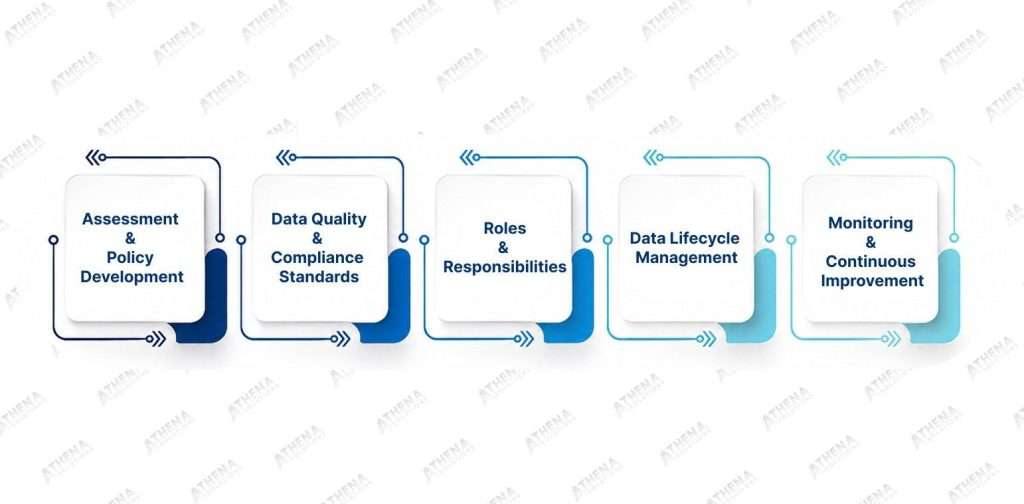
1. Assessment and Policy Development
Before design, we map your current state:
- What data exists
- Where it lives
- Who touches it
- Which decisions it drives
The answers reveal more than our clients expect.
- Data assets nobody knew existed
- Ownership gaps in the most critical areas
- Policies on paper but not in practice
From that foundation, we develop clear policies for governing the creation, access, and use of data, and for what happens when something goes wrong.
2. Data Quality and Compliance Standards
Data quality standards will vary widely by industry and company.
A healthcare payer managing claims under HIPAA is solving a different problem than a financial services firm under SOX, or a manufacturer, where a traceability gap can trigger a recall.
We set precise thresholds, monitoring, and compliance protocols tailored to your industry.
For companies with AI on the horizon, this is where that work begins. The policies, ownership structures, and quality standards defined here decide whether the data feeding your models can be trusted. You can’t govern AI responsibly without first governing the data underneath it.
We cover this in much greater depth in our article, The Most Dangerous Words in AI: Our Data Is Good Enough.
3. Roles & Responsibilities
To bring policy to life, we tie accountability to specific governance roles: data owners, data stewards, and governance councils. Each owns data quality, problem resolution within domains, and keeping policies current.
That accountability is some of the hardest work in an engagement. When Finance and Sales have each been calculating “active customer” their own way for five years, reaching a single definition requires someone to make a call. It requires executive sponsorship and organizational courage. The technology has nothing to do with it.
4. Data Lifecycle Management
Data has a complete lifecycle that requires ongoing management—creation, storage, use, archiving, and deletion.
If creation or storage goes undermanaged, it’s felt immediately. Systems crash and reports stop running, so this portion of the lifecycle is carefully managed. But if archiving or deletion is neglected, there’s no alarm because nobody feels any pain. But storage costs rise, and sensitive data poses unnecessary risk.
This is data management debt. It collects until an audit or migration exposes it. By then, the cost of fixing it is far greater than the cost of managing it would have been.
5. Monitoring and Continuous Improvement
A governance framework is an operating system, not a deliverable. The business changes over time: new products, new markets, new regulations, new teams.
The framework has to change with it. When it doesn’t, people stop trusting it, then stop following it. A functioning governance program fades out without anyone deciding to end it.
The governance programs I’m most proud of are still running five or ten years later. They’re making decisions the original team never anticipated, demonstrating the program’s long-term viability.
That’s the outcome we design for from the first conversation.
What Makes Data Governance Solutions Succeed
The technology is the easy part. I’ve seen companies with best-in-class platforms and governance programs that exist only on paper. I’ve also seen companies with modest tools and governance that actually works — because someone took the time to get the people and process right.
That’s also the pattern behind business intelligence consulting failures: the dashboards are built before the data layer is trusted, and they inherit every definition dispute.
The companies that avoid that outcome are the ones that treated governance as the prerequisite — not the thing they’d get to eventually.
Request Your 30-minute Data Governance Diagnostic.
We’ll review where your governance program stands today, and you’ll leave with a clear view of what’s working, what’s missing, and what to fix before adding more technology.
Key Takeaways
- Data governance solutions include both technology platforms and the organizational programs built around them — neither works without the other.
- The most common reason governance programs fail: data ownership is never clearly assigned.
- Good governance is specific; tailored for your company, owned by a named steward for each critical asset, and adapts as the business changes.
- Deploying a governance platform without establishing accountability is a tool deployment, not a governance program.
- AI governance depends on data governance as its foundation. The ownership structures, quality standards, and policy definitions must be in place before AI initiatives can scale reliably.
- Data management debt is real. Companies carry more of it than they realize, and don’t discover it until a migration, audit, or AI initiative forces it into view.
- Success is measured by durability: a governance program running well three years after implementation, not by go-live.
Frequently Asked Questions
Data governance solutions cover both the technology platforms and the organizational programs that determine how data is created, managed, accessed, and used across your firm. The platforms—catalogs, quality tools, MDM systems, lineage tools, and policy platforms—provide the infrastructure. The organizational layer, ownership, accountability, and processes determine whether that infrastructure delivers lasting value.
A data governance consultant assesses your current data environment, identifies gaps in policy, ownership, and quality, and builds a governance framework tailored to your company's actual operating model. The work is as much organizational as it is technical.
The difference is in who does the work and how long they stay. At large consulting firms, the partners who sell the engagement are rarely the ones who execute it. The institutional knowledge built during scoping doesn't transfer cleanly to the implementation team.
At a boutique firm, the person who understands your business at the start is the same one performing the work.
AI governance frameworks depend on data governance as their foundation. But before a company can govern its AI models responsibly, it needs an underlying governance program. Clear ownership of the data feeding the models, quality standards that can be monitored and enforced, and documented lineage that allows tracing an AI output back to its source.
- Key business questions get different answers depending on who you ask. Finance has one number, Sales has another, and neither can explain why.
- Data quality issues are fixed manually, only to recur.
- AI and analytics initiatives stall because nobody trusts the data underneath them.
- Ask who owns a critical data asset, and the answer is "it depends."
These are all governance problems.
The market separates governance tools into five categories:
- Data catalog platforms profile your data estate to determine what data exists, where it lives, and how it's defined across systems.
- Data quality tools monitor data against the standards your company has set and flag when data falls outside those standards.
- Master data management systems maintain a single authoritative record for core business entities: customers, products, and suppliers.
- Data lineage tools track how data moves and transforms from source to consumption.
- Governance policy platforms manage ownership, access, and stewardship workflows.

