

Data Warehouse Services: Scope, Standards, and How To Choose The Right Partner
May 26, 2026
Data Governance Solutions: What Works, What Fails, and Why
June 8, 2026Avoiding The AI Readiness Self-Assessment Trap

Companies running internal AI readiness assessments are all asking the same question: Are we ready? The problem is that they’re asking the wrong people.
You Asked the Team That Wants AI to Win
Here’s who usually runs it: the same team that built the business case. That is not a character indictment; it’s more about human nature.
The project sponsor wants green lights. The working group wants the budget approved. But nobody in that room has the political cover to say “We’re not ready.”
The instinct isn’t to falsify; it’s to interpret generously. Data quality gaps are noted as ‘manageable.’ Governance documentation that exists on paper, but isn’t enforced in practice, receives a green checkmark.
Accountability questions are also unlikely to be answered fully or authoritatively:
- Who owns this dataset when it’s wrong?
- Who has the authority to stop a launch if the data isn’t ready?
These questions don’t appear on the scorecard because they’re difficult or uncomfortable to answer, or the assessment wasn’t designed to raise them.
This is the self-assessment trap. It isn’t dishonesty. It’s the entirely predictable result of putting the people who want the project to succeed in charge of deciding whether the project should proceed.
In my twenty-plus-year career in data management, I’ve seen this same pattern in project after project. The assessment becomes a confirmation exercise. And by the time that becomes clear, platform contracts are signed, and the honest answer comes with a much higher price tag, both monetary and political.
What the Numbers Actually Say About Organizational AI Readiness
IDC found that only 22% of enterprises that self-assessed as AI-ready actually met readiness thresholds when evaluated by an outside party. Nearly four out of five believed they were ready. They weren’t.
That’s the self-assessment trap.
McKinsey’s Global AI Survey from November 2025 found that 88% of organizations now use AI in at least one function, but only 39% report a measurable impact on EBIT.
The gap between “we implemented AI” and “AI is delivering value” sits almost exactly where the self-assessment trap lies: firms that adopted enthusiastically without candid evaluation.
There’s also a consistent pattern in how leaders and frontline teams perceive organizational AI readiness differently. Leaders, the people approving AI initiatives, systematically overestimate readiness compared to the people doing the day-to-day work.
They’re not operating from the same data. The leader is looking at the strategy deck. The team is looking at the current state of their data quality.
Gartner put an even sharper point on it: 63% of companies either don’t have, or aren’t sure they have, the right data management practices for AI. Most of those organizations have completed some form of AI readiness assessment, but score their data practices higher than reality warrants.
Three Questions Your Scorecard Probably Left Out
Most assessments inventory what you have. A real AI readiness assessment asks who’s accountable. That’s where internal assessments consistently fall short.
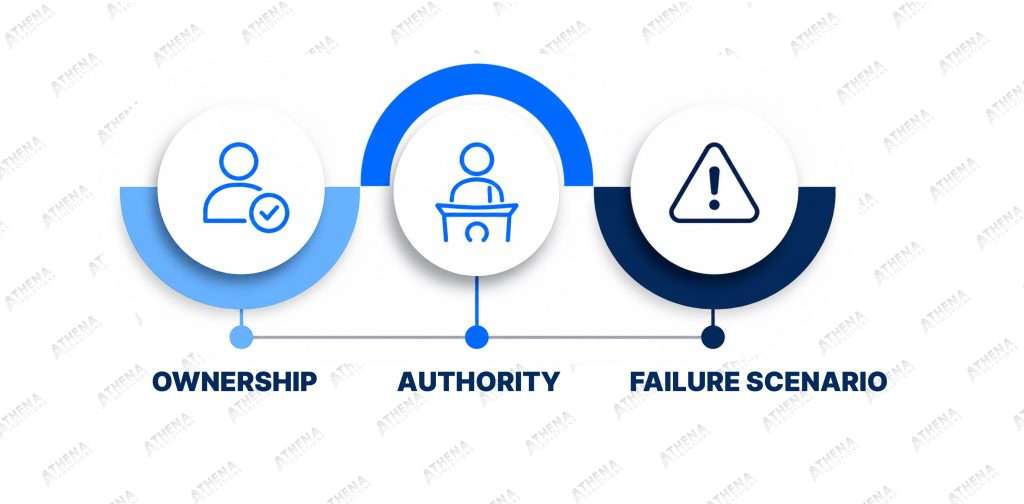
The first question is ownership
Not “do we have a data governance policy” — but “who is accountable when a specific dataset is wrong and a business decision was made on it.” Organizations score themselves well on governance because they have documentation, but that documentation doesn’t have a name attached to it.
Direct accountability does.
The second question is authority
Who can actually stop this launch if the organization isn’t ready? In most cases, it’s nobody. The business case has been built, and the date is on the calendar. Stopping the launch carries a real political cost that most teams won’t entertain. A real assessment asks whether that stop mechanism exists and who is empowered to employ it.
The third question is the failure scenario
What actually happens on the day the model outputs something wrong, and a business decision has already been made on it?
In my experience, very few organizations can answer that with specific roles, a specific sequence of events, and a clear escalation path. If you can’t answer it before you launch, you’re building your governance after the fact. That’s the most expensive way to do it, and the most common reason AI initiatives fail at the organizational layer, not the technical one.
What Changes When the Evaluator Has No Stake in the Answer
The people inside a company know things about their data, their systems, and their culture that no outside party can replicate. That knowledge belongs in the assessment.
The issue is who controls the process.
When the team conducting the assessment also championed the initiative, they’re not positioned to deliver a finding that says “not yet.”
An independent evaluator conducting an AI readiness assessment asks these three questions without political cost, and won’t accept ‘we have a policy‘ as an answer to ‘what actually happens.’
The most common outcome is a better-sequenced initiative. The gaps that surface are the work that needs to happen before launch. Build on what already works. Close the specific gaps most likely to cause failure. Then proceed.
Why the Stakes Are Higher at the Mid-Market Level
Large enterprises with dedicated governance teams, mature analytics, and BI infrastructure have the resources to course-correct mid-initiative. For small and mid-market companies, those resources are rarely in place.
A failed AI initiative will drain budget lines and consume internal credibility for two or three years. And the next proposal carries the weight of the last one. The data management debt that accumulates around a stalled initiative—ungoverned models, siloed datasets, undocumented decisions—becomes part of the infrastructure the next team inherits.
The self-assessment trap is also more pronounced here. Mid-market leadership teams are close enough to the work to have strong opinions, and senior enough to shape the assessment without running it. That’s the environment where optimistic scoring is most likely.
Separate the Evaluator From the Advocate
If you’re planning an AI initiative right now, start with this question: Who in your organization has both the incentive and the authority to give you an honest read on your AI readiness?
If that answer is hard to find, that’s where you need to start.
An honest AI readiness assessment doesn’t tell you to stop. It tells you what needs to happen before you do.
Know where your company actually stands on AI readiness before the platform decision is made and before the budget is committed.
We conduct ours with senior practitioners, without a platform to sell and without any stake in a particular outcome.
The findings are honest. So is the path forward.
Frequently Asked Questions
An AI readiness assessment is a structured evaluation of whether an organization's data, technology, processes, people, and governance are genuinely prepared to support a successful AI initiative.
IDC found that only 22% of enterprises that self-assessed as AI-ready actually met the readiness thresholds in an independent evaluation. Internal assessments are conducted by teams that are also advocating for the AI initiative moving forward. That creates a structural conflict: the same people evaluating readiness have a stake in the project proceeding.
A thorough AI readiness assessment framework covers five core areas: data quality and governance, technology infrastructure, talent and skills, process maturity, and leadership alignment.
An external assessment is conducted by someone with no stake in the outcome. That independence changes what questions get asked, what answers get accepted, and what the results can actually contain.
Before the platform decision is made and before the budget is committed. The earlier it runs, the more it can actually shape the investment. The later it runs, the more it becomes a formality.
A real assessment produces a prioritized gap analysis: what must close before launch, what can run in parallel, and what is a longer-term capability investment. The goal is to build on what already works in your data and process environment, close the specific gaps most likely to cause the initiative to fail, and proceed on a timeline that reflects reality rather than external pressure.

